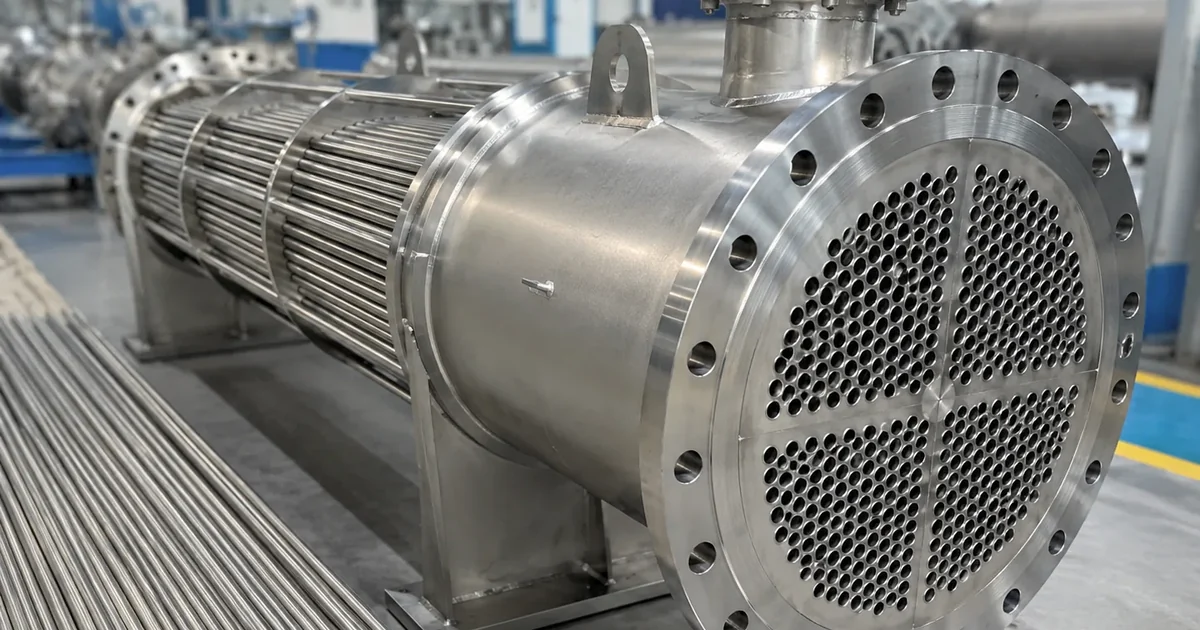
For an industrial heat exchanger, choosing between titanium and 316L stainless steel tubes is not a simple question of which metal is “better.” 316L is economical, widely available and suitable for many moderate industrial duties. Titanium, especially Grade 2, is often selected when seawater, high chloride exposure, crevices or the cost of tube failure makes localized corrosion a more serious project risk. The correct choice depends on the process, not the material name.
Titanium vs 316L heat exchanger tubes: quick comparison
| Procurement factor | Titanium Grade 2 | 316L stainless steel |
|---|---|---|
| Typical buyer objective | High resistance in seawater and chloride-rich heat-transfer service | Cost-effective corrosion resistance for moderate industrial service |
| Common tube specification | ASTM B338 | ASTM A213/A213M, A249/A249M or other project-approved specification |
| Density | About 4.5 g/cm³ | About 8.0 g/cm³ |
| Room-temperature thermal conductivity | Broadly similar range to 316L for engineering comparison | Broadly similar range to titanium for engineering comparison |
| Chloride pitting / crevice risk | Very strong resistance in many seawater and chloride duties | Needs careful review as chloride, temperature and crevice severity increase |
| Initial material cost | Usually higher | Usually lower |
| Fabrication familiarity | Requires disciplined inert-gas shielding and contamination control | Widely familiar to fabricators and maintenance teams |
| Lifecycle economics | Can be attractive where corrosion-related shutdown or retubing is costly | Can be attractive where the environment is moderate and replacement risk is low |
These are general procurement characteristics. Final selection should be based on the approved process data, code basis, corrosion review and equipment design.
Where 316L stainless steel performs well
316L is one of the most familiar austenitic stainless steels used in industrial equipment. The molybdenum addition improves resistance to localized corrosion compared with 304-type stainless steels, while the low-carbon grade supports welded fabrication where sensitization control matters.
For heat exchangers, 316L can be a practical choice in:
- clean or controlled cooling-water systems;
- process fluids with moderate corrosion severity;
- food, pharmaceutical and general industrial service;
- systems where chloride level and temperature remain within the approved corrosion envelope;
- projects where standard stainless fabrication, availability and cost are important;
- equipment that can be inspected or retubed without major plant consequence.
The mistake is not using 316L. The mistake is using 316L because “stainless steel does not rust” without checking the actual process environment.
Why chlorides change the comparison
Stainless steels rely on a passive chromium-rich surface film. Chlorides can locally damage that passive state and create pitting and crevice corrosion. The risk is influenced by chloride concentration, temperature, pH, deposits, oxidizing conditions and geometry. Tight tube-to-tubesheet joints, gasketed areas and fouled surfaces can be more severe than the bulk process fluid.
This is why a single chloride ppm number is not enough to approve 316L for a heat exchanger. The same chloride concentration can behave very differently at different temperatures or inside a stagnant crevice.
Outokumpu's published 316L corrosion data also emphasizes that chloride contamination increases pitting, crevice-corrosion and stress-corrosion-cracking risk, and that temperature and service conditions matter. For a real project, use the purchaser's corrosion review rather than a generic internet limit.
Why titanium is frequently selected for seawater
Titanium forms a stable, adherent oxide film and has an established record in seawater heat exchangers, condensers and desalination equipment. Grade 2 is therefore a common industrial choice where continuous seawater exposure would create a greater localized-corrosion concern for conventional austenitic stainless steel.
Common applications include:
- seawater heat exchangers;
- coastal power-plant condensers;
- desalination systems;
- marine cooling equipment;
- offshore heat-transfer systems;
- brackish-water equipment;
- chemical heat exchangers with chloride-containing streams.
For seawater-specific procurement, see Titanium Tube for Desalination & Seawater Service.
Titanium is not automatically correct for every chemical stream
Titanium's strong performance in seawater does not mean it is universally resistant to every chemistry. Reducing acids, fluoride-bearing environments and unusual process contaminants can change material behavior. That is why a buyer should never replace a corrosion-engineering review with a statement such as “titanium handles all chemicals.”
If the project is already considering different titanium grades for chloride service, review: Grade 2 vs Grade 12 Titanium Tube for Chloride Service.
Thermal conductivity: do not choose from one property number
A common purchasing question is whether titanium transfers heat better or worse than 316L. At room temperature, the thermal conductivities of commercially pure titanium and 316L stainless steel are in a broadly comparable range for practical exchanger discussions. The overall exchanger duty, however, depends on much more than the metal conductivity.
The overall heat-transfer coefficient is influenced by:
- tube wall thickness;
- inside and outside fluid-film coefficients;
- fluid velocity;
- fouling resistance;
- surface condition;
- tube diameter;
- flow arrangement;
- temperature difference;
- corrosion products and deposits during service.
A titanium tube may also be designed with a different wall thickness than a stainless tube, which changes wall resistance and total tube weight. Therefore the thermal comparison must be performed on the actual exchanger design, not on a material-property table alone.
Wall thickness can change the commercial comparison
Comparing titanium and 316L at the same price per kilogram is often misleading. Titanium has substantially lower density, and the approved tube wall may also differ between material options. The purchaser should compare the complete engineered tube bundle:
A higher kilogram price does not automatically produce the same increase in total bundle cost. Conversely, a thinner titanium wall must never be assumed without confirming pressure design, erosion allowance, vibration, handling and tube-to-tubesheet requirements.
Initial price vs lifecycle cost
316L normally has an advantage in initial material price and supply familiarity. For moderate service, that can make it the correct economic material.
Titanium becomes more commercially interesting when failure consequences dominate the analysis. Lifecycle factors may include:
- frequency of tube plugging;
- planned or unplanned retubing;
- lost production during exchanger shutdown;
- contamination between shell-side and tube-side fluids;
- spare bundle requirements;
- inspection frequency;
- maintenance access;
- expected project operating life.
The material with the lower purchase price is not always the material with the lower total cost of ownership. But titanium is also not automatically the lower lifecycle-cost choice if the service is mild and 316L can operate reliably for the required design life.
ASTM standards: make sure the quotations are technically comparable
Titanium and stainless steel tubes are not purchased under the same product specification.
| Material / construction | Common specification | Procurement note |
|---|---|---|
| Titanium heat-exchanger tube | ASTM B338 | Covers seamless and welded titanium and titanium-alloy condenser and heat-exchanger tubes |
| 316L seamless heat-exchanger tube | ASTM A213/A213M | Common specification for seamless austenitic alloy-steel boiler, superheater and heat-exchanger tubes |
| 316L welded heat-exchanger / condenser tube | ASTM A249/A249M | Common specification for welded austenitic steel boiler, superheater, heat-exchanger and condenser tubes |
| 316L general-service tubing | ASTM A269/A269M | General-service austenitic stainless tubing; not a substitute for the project-required exchanger specification |
Always state the exact project-approved standard, edition and supplementary requirements. Two suppliers can quote the same nominal material grade but a different tube standard, manufacturing route or test scope.
For titanium purchasing details, see ASTM B338 Titanium Tube RFQ Guide.
Seamless vs welded construction is a separate decision
Do not mix material selection with manufacturing-route selection. Titanium Grade 2 may be supplied as seamless or welded tube when the project specification permits it. Stainless heat-exchanger tubing also has separate seamless and welded product specifications.
The RFQ should explicitly identify:
- whether seamless construction is mandatory;
- whether welded construction is acceptable;
- required NDT method and extent;
- pressure-test requirement;
- surface condition;
- dimensional tolerance;
- weld-related documentation where applicable.
For titanium specifically, read Titanium Seamless Tube vs Welded Tube.
Fabrication and welding differences
316L fabrication is widely familiar across heat-exchanger shops. Titanium is also weldable, but it is more sensitive to atmospheric contamination at welding temperature and requires disciplined inert-gas shielding, clean tooling and controlled handling.
For equipment manufacturers, this means material price is not the only fabrication consideration. The shop should have procedures, personnel and cleanliness practices appropriate for the selected alloy.
For procurement teams buying only straight tubing rather than fabricated exchangers, the RFQ should still define tube-end cleanliness and protection if subsequent welding or tube-sheet work is planned.
Fouling, cleaning and surface condition
Heat-exchanger performance deteriorates when deposits accumulate, regardless of tube alloy. Fouling depends on water chemistry, temperature, velocity, biology and cleaning practice. A corrosion-resistant alloy does not eliminate the need for appropriate cleaning design.
Before approving either material, review:
- expected biological fouling;
- scale-forming tendency;
- mechanical cleaning method;
- chemical cleaning agents;
- cleaning frequency;
- compatibility of cleaning chemistry with the selected alloy.
This is particularly important where cleaning chemicals create a more aggressive environment than the normal process stream.
When 316L is likely to be the better purchasing choice
316L may be the more rational option when:
- service water is controlled and chloride severity is moderate;
- the approved corrosion assessment accepts 316L;
- temperature does not create unacceptable chloride-SCC or localized-corrosion risk;
- the exchanger is accessible for inspection and maintenance;
- initial capital cost is important;
- standard stainless fabrication and rapid replacement availability are valuable;
- the operating history already demonstrates acceptable 316L life in the same service.
In those conditions, specifying titanium only because it is more corrosion resistant can add cost without solving a real project problem.
When titanium is more likely to justify the premium
Titanium may deserve stronger consideration when:
- the cooling medium is natural seawater;
- chloride concentration is high or variable;
- crevices and deposits are difficult to avoid;
- long uninterrupted operating campaigns are required;
- retubing is difficult or expensive;
- a tube leak creates serious contamination or production consequences;
- maintenance access is poor;
- existing 316L service history shows pitting, crevice attack or cracking;
- the owner is evaluating lifecycle cost rather than only initial purchase price.
For power-generation applications, see Titanium Condenser Tubes for Power Plants.
What about duplex or super duplex instead?
The real material shortlist is sometimes broader than titanium versus 316L. Duplex and super-duplex stainless steels can provide higher strength and improved chloride resistance compared with 316L, and may be attractive in some seawater or high-chloride duties.
That choice introduces its own fabrication, welding, phase-balance, procurement and corrosion considerations. If the process is severe enough that 316L is marginal, buyers should ask the project materials engineer whether the true comparison should be among titanium, duplex/super duplex or a nickel alloy rather than simply “titanium vs 316L.”
RFQ checklist for titanium vs 316L comparison
| RFQ field | What to provide |
|---|---|
| Application | Heat exchanger, condenser, cooler, evaporator or replacement bundle |
| Process medium | Cooling water, seawater, brine, chemical stream and relevant impurities |
| Chloride concentration | Normal and maximum value if available |
| pH | Normal operating range and abnormal conditions if relevant |
| Temperature | Operating, maximum and design temperature |
| Pressure | Operating and design pressure |
| Material option | Titanium Grade 2, 316L, or request separate alternate quotations |
| Standard | ASTM B338, A213/A213M, A249/A249M or project-specific standard |
| Construction | Seamless / welded / approved alternatives |
| Dimensions | OD × wall thickness × finished length |
| Quantity | Pieces by size plus approved spare allowance |
| Inspection | NDT, pressure test, dimensional inspection, witness / hold points |
| Documents | MTC, traceability, inspection reports and TPI requirements |
| Packing | Long-tube protection, crate / bundle requirement and marking |
| Delivery | Country, port, incoterm and required arrival date |
How to request alternate quotations correctly
If engineering permits both materials, the purchaser can ask suppliers to quote separate alternatives. The important point is to keep each option technically complete.
Option B: ASTM A213/A249 TP316L tube as approved · OD ___ × WT ___ × L ___ · ___ pcs · test/document scope ___
If wall thickness, tube construction or testing differs between options, identify those differences explicitly. A commercial comparison is meaningful only after engineering has normalized the design basis.
Supplier evaluation: do not compare only alloy names
For international procurement, evaluate whether the supplier can support the complete specification:
- correct material grade and standard;
- required seamless or welded route;
- fixed-length capability;
- thin-wall dimensional control;
- inspection and test scope;
- material traceability;
- document package;
- export packing for long tubes;
- technical-deviation control;
- realistic delivery schedule.
For a broader purchasing checklist, see Titanium Tube Supplier Selection Guide.
Frequently asked questions
Is titanium better than 316L for seawater?
Titanium Grade 2 is often selected for continuous seawater and high-chloride heat-transfer duty because of its strong resistance to localized chloride corrosion. Final selection still depends on the complete service environment and approved materials specification.
Does titanium transfer heat better than 316L?
Do not decide from conductivity alone. Overall exchanger performance depends on wall thickness, fluid-film coefficients, velocity, fouling, surface condition and exchanger geometry.
Why is 316L usually cheaper?
316L normally benefits from a larger supply base, lower initial material cost and widespread fabrication experience. Titanium may justify its premium where corrosion-related maintenance and shutdown risk are more important.
Which ASTM standards are used?
ASTM B338 is commonly used for titanium condenser and heat-exchanger tubes. Depending on construction and project scope, 316L heat-exchanger tubing may be specified under ASTM A213/A213M or A249/A249M.
Can I ask suppliers to quote both materials?
Yes, if engineering permits alternate materials. Keep each option on a complete and normalized technical basis so the commercial comparison is meaningful.
Reference sources
Titanium tube standard: ASTM B338-17(2026) — Seamless and Welded Titanium and Titanium Alloy Tubes for Condensers and Heat Exchangers.
Stainless tube standards: ASTM Book of Standards — A213/A213M-25 and related steel tube standards, and ASTM A269/A269M-25.
316L chloride-corrosion context: Outokumpu 316L / Supra corrosion data and Nickel Institute — localized and chloride corrosion of stainless steels.
Send your titanium heat exchanger tube RFQ
Send the process medium, chloride level, temperature, tube size, quantity, required standard and inspection scope. If your project is comparing materials, attach the exchanger datasheet or approved tube schedule.
 Scan to chat on WhatsApp