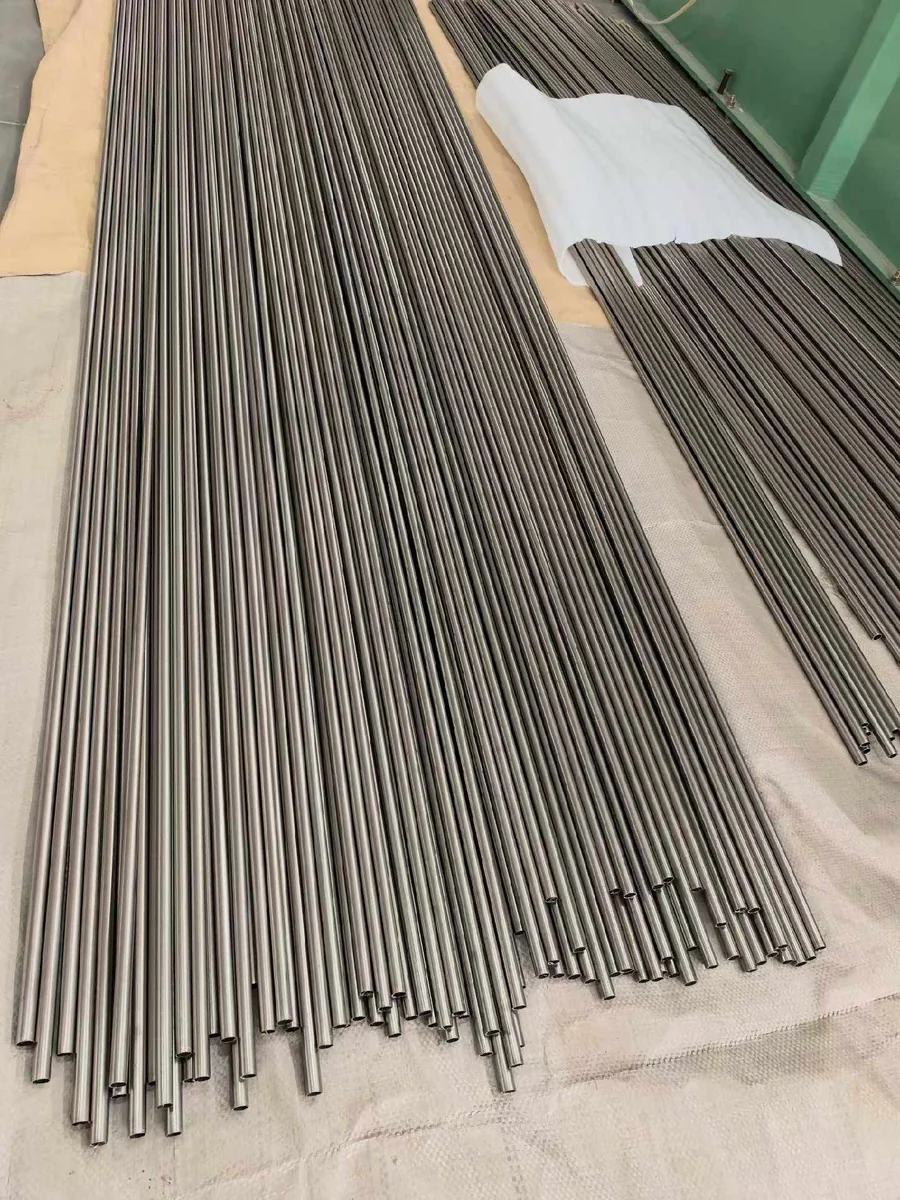
Selecting a titanium tube supplier involves much more than comparing unit prices. For industrial buyers sourcing titanium tubing for heat exchangers, chemical processing equipment, seawater systems, condensers or corrosion-resistant piping, the final value of a quotation depends on manufacturing route, dimensional capability, inspection scope, material traceability, documentation and the supplier's ability to understand the project specification.
1. Start with the actual titanium tube application
The first procurement question should not be only “what is your price?” It should be “what service conditions must the titanium tube withstand?” Titanium tubing is used in shell-and-tube heat exchangers, condensers, evaporators, chemical process equipment, seawater cooling systems, desalination plants, chloride-bearing service and corrosion-resistant piping.
A tube installed in a condenser can have very different dimensional, surface and inspection requirements from a large-diameter welded titanium pipe used in a process line. A capable supplier should review the application before confirming the most suitable manufacturing route and quotation basis.
2. Confirm whether seamless or welded titanium tube is required
Seamless titanium tube
Seamless tubing has no longitudinal weld seam and is commonly specified for heat exchangers, condenser tubes, critical process tubing and applications where dimensional consistency and tube integrity are important.
Titanium welded tube & pipe
Welded titanium tube is formed from strip, sheet or plate and welded longitudinally. It can offer advantages for larger diameters, custom dimensions, long production runs and project-specific piping.
Neither route is automatically “better” for every project. The selection should follow the equipment design, purchase specification, operating conditions and acceptance requirements. For a deeper comparison, read our welded pipe vs. seamless titanium tube procurement guide.
3. Check the applicable ASTM or ASME standard
Industrial titanium tubes and pipes are often purchased to recognized product specifications. Common examples include ASTM B338 for titanium and titanium-alloy tubes used in condensers and heat exchangers, ASTM B861 for seamless titanium pipe and ASTM B862 for welded titanium pipe. The project may also identify an ASME-adopted specification or an owner/EPC requirement.
The standard affects chemistry, mechanical properties, dimensional requirements, manufacturing route and testing. Buyers should avoid sending only a dimension such as “25 × 1 mm titanium tube” when a governing specification is required by the project.
For heat-transfer tubing, see our Titanium Heat Exchanger Tube product page and ASTM B338 buyer guide.
4. Verify material traceability
Traceability is a core part of industrial titanium procurement. Depending on the purchase order, the supplier may need to connect finished tubes to heat or lot identification, raw-material records, inspection documents and the final material test certificate.
- Heat or lot number identification
- Raw-material and finished-product traceability
- Mill Test Certificate (MTC)
- Inspection and NDT reports when required
- Marking and packing identification
For EPC companies and equipment manufacturers, these records can become part of the final project documentation package, so the required document scope should be defined before production.
5. Review dimensional capability, not only material grade
A supplier may be able to source the required titanium grade but still be unsuitable for the required tube geometry. Procurement should confirm outside diameter, wall thickness, length, OD tolerance, wall tolerance, straightness, ovality and end condition.
For heat exchanger applications, dimensional consistency is especially important because tubes must pass through tube sheets, baffles and support plates and may need to suit expansion or welding operations. Small deviations can create installation problems even when the chemistry is correct.
6. Pay attention to wall thickness
Wall thickness affects mechanical strength, heat-transfer performance, weight, forming behavior, corrosion allowance and cost. Thin-wall heat exchanger tubing requires controlled production and inspection; process piping may require a wall thickness determined by pressure, temperature, corrosion conditions and mechanical design.
The RFQ should therefore state nominal wall thickness and any tighter tolerance required by the equipment design.
7. Define the required surface condition
Titanium tube surface requirements vary by application. Buyers may need pickled, annealed, mechanically finished, chemically cleaned or other project-specified conditions. Surface acceptance should also consider scratches, dents, embedded contamination, oxidation, handling damage and tube-end condition.
For heat exchanger tubing, both OD and ID surface quality may matter, so inspection language should be clear rather than simply saying “good surface.”
8. Understand welding quality for titanium welded pipe
Titanium is reactive with oxygen, nitrogen and hydrogen at elevated temperature, so welding quality depends heavily on preparation, shielding and process control. When buying welded titanium pipe, the project should consider weld preparation, shielding gas, root protection, heat input, weld appearance and the required NDT or acceptance method.
Poor shielding can cause oxidation or contamination in the weld region. A serious welded-pipe quotation should therefore be reviewed together with the applicable standard and project inspection scope.
9. Define inspection before production
Industrial buyers should include required inspection in the RFQ or purchase order, not wait until the material is finished. Depending on the product and governing standard, the scope may include:
Chemical & mechanical verification
Chemical composition, tensile properties and other required material tests establish compliance with the specified grade and standard.
Dimensional inspection
OD, wall thickness, length, straightness, ovality and visual condition should be checked according to the applicable acceptance basis.
NDT / pressure testing
Eddy current, ultrasonic, hydrostatic or other methods may apply depending on the product specification, project requirement and manufacturing route.
Documentation
Define whether the PO requires MTCs, NDT reports, dimensional reports, traceability records, third-party inspection or other project dossiers.
10. Review the Mill Test Certificate
A material certificate can contain the material grade, heat number, chemistry, mechanical properties, standard and other results required by the purchase specification. Buyers should decide at RFQ stage which certificate and supporting reports are required so that document preparation is part of the quoted scope.
11. Heat exchanger tube buyers need tighter procurement control
A heat exchanger can contain hundreds or thousands of tubes, so repeated small deviations can become major fabrication problems. Buyers should clearly define ASTM standard, grade, outside diameter, wall thickness, length, dimensional tolerances, NDT, surface condition, packing and documentation.
Our Titanium Heat Exchanger Tubes buyer guide explains how to structure this type of RFQ in more detail.
12. Packaging should be part of the technical scope
International transport can damage long titanium tubes if packaging is weak or the tube ends are unprotected. Typical risks include tube-end deformation, scratching, bending, contamination, moisture exposure and bundle movement.
Depending on the order, packaging may include end protection, bundled tubes, waterproof wrapping, export wooden cases, identification labels and lifting provisions. Long-length tube orders should be reviewed for package strength as well as product quality.
13. Compare quotations on the same technical basis
Supplier A may quote material with the specified standard, inspection, MTC and export packing, while Supplier B may quote a reduced scope. The lower unit price may therefore be misleading. Procurement teams should normalize the technical basis before comparing commercial values.
| Comparison item | What buyers should normalize |
|---|---|
| Material | Grade, product specification and approved standard edition |
| Manufacturing route | Seamless or welded, plus any required condition |
| Dimensions | OD, wall, length and tolerances |
| Testing | NDT, pressure testing, dimensional and visual inspection |
| Documents | MTC, traceability, inspection reports and third-party requirements |
| Packing | Export packing, end protection, bundle/box requirements |
| Delivery | Incoterm, destination, schedule and freight scope |
14. Evaluate supplier communication capability
Titanium tube procurement is often drawing- and specification-driven. A supplier should be able to understand common industrial RFQ language such as OD × WT × L, seamless/welded route, ASTM specification, quantity, service condition, NDT and documentation requirements.
Fast replies are useful, but accurate technical clarification is more important. A supplier that identifies missing data before quotation can reduce the risk of specification disagreements after the purchase order is issued.
15. What information should be included in a titanium tube RFQ?
| RFQ item | Example |
|---|---|
| Product | Titanium Seamless Tube |
| Material grade | As specified by project |
| Standard | ASTM B338 |
| Outside diameter | 25.4 mm |
| Wall thickness | 0.7 mm |
| Length | 6,000 mm |
| Quantity | 5,000 m |
| Inspection | State NDT / dimensional requirements |
| Documentation | MTC + required reports |
| Application | Heat exchanger / process piping |
| Delivery | Destination and required date |
For a copy-and-send checklist, use our How to Specify Titanium Tubes for an RFQ guide.
16. Questions buyers should ask a titanium tube supplier
- Can you supply the required seamless or welded titanium tube?
- Which product standards can you quote against?
- Can you meet the requested OD, wall and length tolerances?
- What inspection and NDT methods are available?
- How is material traceability maintained?
- Which certificates and reports can be supplied?
- What packing method will be used?
- Can you support fixed/custom lengths?
- Which technical details must be confirmed before production?
- What is the expected manufacturing and delivery schedule?
17. Titanium tube supply from Baoji, China
Baoji is a major titanium industrial cluster in China, with a supply chain covering raw material, tubing, plate, strip, forging, machining, fittings, flanges and equipment fabrication. For overseas procurement teams, access to multiple titanium product forms can be useful when one project requires tubes together with related fabricated components.
18. Our titanium tube supply scope
Shaanxi Zhongying Dicheng Metal Materials Co., Ltd. supports project-based titanium procurement including titanium seamless tube & pipe, titanium welded tube & pipe, titanium heat exchanger tube, titanium fittings, flanges, fabricated components and titanium process equipment.
Quotation and production are based on the confirmed material requirement, dimensions, standard, drawing, inspection scope, purchase order and technical agreement.
| Supplier check | Questions to confirm |
|---|---|
| Product capability | Can the supplier make the required seamless/welded route and size range? |
| Standards | Can the quotation comply with the specified ASTM/ASME/project requirements? |
| Quality control | Which inspections and NDT methods are included, and what reports are issued? |
| Traceability | How are heat/lot identification and certificates linked to the finished tubes? |
| Documents | Can the supplier provide the required MTC, dimensional report, NDT report and project dossier? |
| Deviation control | Will all deviations be clearly listed with the quotation? |
| Packing | How will long tubes and tube ends be protected for international shipment? |
| Schedule | What are the production, inspection, document and shipment lead times? |
24. A practical supplier comparison checklist
For this reason, industrial buyers should evaluate a titanium tube supplier across five dimensions: technical capability, specification compliance, quality control, documentation discipline and delivery reliability. Commercial price should then be compared after these requirements are aligned.
The lowest purchase price is only one part of total procurement cost. Material rejection, incorrect documentation, delayed delivery, damaged packaging, dimensional mismatch or unclear traceability can create much larger downstream costs during fabrication and project execution.
23. Use supplier evaluation to reduce total procurement risk
Late introduction of inspection requirements can cause rework, repeat testing or shipment delay even when the tubes themselves meet the material specification.
Some EPC and end-user projects require third-party inspection, witness points or document approval before shipment. These requirements can affect both price and lead time. If a third-party agency must witness testing, review certificates or release the material, state this in the RFQ and identify the required inspection stage where possible.
22. Third-party inspection and hold points should be agreed early
When delivery is critical, ask the supplier to separate material availability, production time, inspection/document preparation and transport time. This gives procurement teams a more realistic view of the schedule than a single “delivery in 30 days” statement.
Lead time is not independent from specification. Tight tolerances, special lengths, additional NDT, third-party witnessing, unusual documentation, custom packing and project hold points can all affect the manufacturing schedule.
21. Review production lead time together with the technical scope
For project procurement, buyers can add a simple instruction such as: “Supplier shall list all technical and commercial deviations with the quotation.” This makes bid comparison faster and reduces the chance that an important difference is discovered only after purchase order placement.
A professional quotation should make technical deviations visible. If the requested dimension, standard edition, inspection method or delivery condition cannot be offered exactly, the supplier should identify the deviation rather than silently quoting an alternative.
20. Ask how deviations will be handled
This matters because an unusual size may require special raw material, tooling, production routing or minimum quantity. A supplier that clearly identifies these constraints at RFQ stage is easier to evaluate than one that confirms every requirement without technical clarification.
“Titanium tube supplier” is a broad description. One supplier may specialize in small-diameter heat exchanger tubing, while another may be stronger in welded pipe, thicker-wall product or custom fabrication. Before comparing quotations, ask whether the requested OD, wall thickness, length and quantity fall within the supplier's normal production range.
19. Check whether the supplier can support your actual size range
Request a titanium tube quotation
Send product type, standard, OD, wall thickness, length, quantity, service application, inspection requirements, documentation and destination. Drawings, BOMs and technical specifications are welcome.
 Scan to chat on WhatsApp