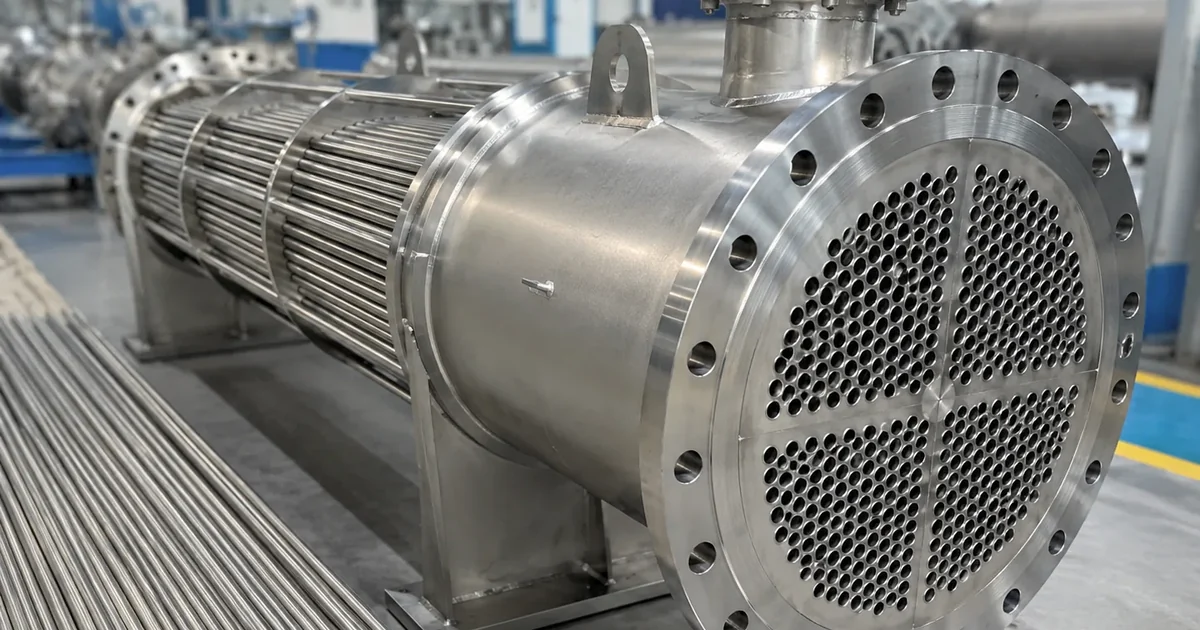
For titanium heat exchanger tubes, OD × wall thickness × finished length is one of the first pieces of information a supplier needs. But buyers should not select a tube only because a size appears in a supplier catalogue. The correct dimension is tied to the exchanger design, pressure, tube sheet, support spacing, vibration, fouling, heat-transfer duty and inspection requirements.
Common titanium heat exchanger tube OD examples
The following are common market examples found in international heat-exchanger and condenser tube supply. They are not a complete ASTM B338 dimensional table and should not replace the exchanger drawing.
| Outside diameter | Imperial reference | Typical purchasing context |
|---|---|---|
| 12.70 mm | 1/2 in | Compact heat-transfer equipment and project-specific bundles |
| 15.88 mm | 5/8 in | Condensers, coolers and compact exchanger bundles |
| 19.05 mm | 3/4 in | Very common condenser and heat-exchanger quotation size |
| 25.40 mm | 1 in | Larger tube-side flow area and project-specific exchanger designs |
| 31.75 mm | 1-1/4 in | Higher-flow or special industrial exchanger designs |
| 38.10 mm | 1-1/2 in | Specialized heat-transfer or process-equipment requirements |
These dimensions are frequently quoted in the market, but final suitability depends on the equipment design. If the tube sheet was drilled for 19.05 mm tubing, changing to 25.4 mm is not a commercial substitution—it is an equipment redesign.
Common wall-thickness examples
Common quotation ranges for heat-exchanger tubing often include walls from approximately 0.5 mm to 2.0 mm, with thinner or heavier walls available for specific designs and manufacturing routes. Examples frequently encountered in market specifications include 0.5, 0.7, 0.9, 1.0, 1.2, 1.5 and 2.0 mm.
| Wall thickness example | Procurement consideration |
|---|---|
| 0.5–0.7 mm | Thin-wall heat-transfer service where the approved design allows it; dimensional control and handling become more important |
| 0.8–1.0 mm | Common engineering range for many industrial exchanger RFQs |
| 1.2–1.5 mm | Higher mechanical margin, heavier tube weight and greater wall thermal resistance |
| 2.0 mm and above | Project-specific pressure, mechanical or process requirement rather than a default heat-exchanger choice |
Do not treat these ranges as engineering recommendations. Wall thickness must be approved by the exchanger designer.
Why thinner wall is not automatically better
Reducing wall thickness can reduce tube weight and metal thermal resistance, but the tube must still withstand production, transport, installation and service. The design review should consider:
- internal and external pressure;
- tube vibration and support spacing;
- tube-to-tubesheet rolling, expansion or welding;
- erosion and velocity;
- handling damage;
- manufacturing tolerance;
- cleaning method;
- expected service life;
- applicable code and purchaser minimum thickness.
Why thicker wall is not automatically safer
A heavier wall can increase mechanical margin, but it also increases material weight and wall thermal resistance. It may also change tube expansion behavior and the tube-to-tubesheet joint. Simply increasing wall thickness without rechecking the exchanger design can create a different set of problems.
19.05 mm titanium tube: why buyers see this size often
The 19.05 mm (3/4 in) outside diameter appears frequently in heat-exchanger and condenser procurement because it provides a practical balance among heat-transfer area, tube count, mechanical handling and established exchanger geometry.
That does not mean every 19.05 mm tube is interchangeable. A valid RFQ still needs the exact wall, finished length, grade, standard, construction and inspection requirement.
25.4 mm titanium tube: when larger OD may appear
A 25.4 mm (1 in) tube provides a larger internal flow area than smaller OD tubing, but its use changes tube count, tube-sheet drilling, pitch and exchanger geometry. Buyers replacing an existing bundle should therefore copy the approved drawing dimensions rather than choosing a “standard” 1-inch tube from a catalogue.
Finished length matters as much as OD and wall
Heat exchanger and condenser projects often require fixed-length tubes. Finished length affects:
- tube-sheet engagement;
- bundle assembly;
- field trimming allowance;
- expansion or welding sequence;
- export packing;
- transport container planning.
For long tubes, state whether the quoted length is exact finished length, mill length or cut-to-length requirement, and define the acceptable tolerance if the project is tighter than the base material standard.
ASTM B338: what it does and does not replace
ASTM B338 covers seamless and welded titanium and titanium-alloy tubes for surface condensers, evaporators and heat exchangers. It establishes material and product requirements, but the buyer still needs to define the required grade, tube construction, dimensions and purchase details.
For specification planning, see ASTM B338 Titanium Tube RFQ Guide.
Seamless vs welded route can affect size availability
The most economical manufacturing route can vary with OD, wall thickness, length, quantity and project requirements. A dimension that is straightforward for one manufacturing route may be less efficient for another.
If the engineering specification permits either route, ask the supplier to identify:
- seamless or welded construction;
- production route;
- applicable heat treatment;
- NDT and pressure-test basis;
- dimensional capability;
- maximum finished length;
- commercial difference between alternatives.
Read Titanium Seamless Tube vs Welded Tube before allowing an alternate route.
Tube size affects theoretical weight and total project cost
For a round tube, metal cross-sectional area increases with both OD and wall thickness. For commercially pure titanium, a rough theoretical mass calculation can be useful for checking quotations, but final commercial weight must follow the agreed calculation method, tolerances and actual order dimensions.
This is why comparing suppliers only by USD/kg can be misleading. Two quotations may use different walls, lengths, tolerances, inspection scopes or packaging.
How OD and wall affect heat-transfer design
Changing tube OD changes the available external heat-transfer area per tube, tube count and shell-side geometry. Changing wall thickness changes wall thermal resistance and internal flow area. The exchanger designer therefore evaluates the entire thermal and hydraulic system rather than optimizing a single tube dimension.
How corrosion service affects dimension selection
Titanium is often selected because of corrosion resistance, especially in seawater and chloride-containing service. But corrosion resistance does not remove the need for mechanical design. The wall selected for a clean seawater cooler may differ from a tube exposed to vibration, solids, aggressive cleaning or unusual process conditions.
For seawater projects, see Titanium Tube for Desalination & Seawater Service.
Dimensional inspection before shipment
The RFQ should identify how OD, wall and length will be verified. Depending on the project, incoming or pre-shipment inspection may include:
- OD measurement;
- wall-thickness measurement;
- finished-length verification;
- straightness or ovality when project-specific;
- surface and tube-end inspection;
- heat/lot traceability;
- NDT and pressure-test reports;
- third-party inspection where required.
Use the ASTM B338 Titanium Tube Inspection Checklist for a fuller release plan.
RFQ table: dimensions and technical details
| RFQ field | Example / buyer requirement |
|---|---|
| Product | Titanium heat exchanger tube |
| Grade | Grade 2, Grade 7, Grade 12 or approved project grade |
| Standard | ASTM B338 / ASME SB-338 as specified |
| Construction | Seamless, welded or approved alternate |
| OD | Example: 19.05 mm |
| Wall thickness | Example: 0.7 mm |
| Finished length | Example: 6000 mm |
| Quantity | Pieces by exact size |
| Tolerances | Base standard or project-specific tighter requirement |
| Inspection | Applicable NDT, pressure test, dimensional report, PMI/TPI if required |
| Documents | MTC/MTR, traceability and inspection reports |
| Packing | Long-tube export crate/bundle and end protection |
| Delivery | Destination, incoterm and required arrival date |
Example titanium tube RFQ
ASTM B338 Grade 2 Titanium Heat Exchanger Tube
19.05 mm OD × 0.70 mm WT × 6000 mm finished length
500 pcs
Seamless or welded: ___
Inspection: applicable ASTM B338 NDT + dimensional report + MTC
Packing: export wooden case / long-tube protection
Destination: ___
Common buyer mistakes
- writing only “3/4 inch titanium tube” without wall thickness;
- using nominal pipe size terminology for a heat-exchanger tube RFQ;
- forgetting the finished length;
- changing OD without checking the tube sheet;
- selecting the thinnest wall only to reduce price;
- not stating seamless or welded construction;
- mixing ASTM B338 heat-exchanger tube with general titanium pipe specifications;
- comparing quotations with different inspection scopes;
- not defining tight project tolerances before production.
Related titanium tube guides
- Titanium Tube Supplier & Product Hub
- Titanium Heat Exchanger Tube
- Titanium Heat Exchanger Tubes Buyer Guide
- Titanium Seamless Tube
- Titanium Welded Tube
- ASTM B338 Titanium Tube RFQ Guide
- How to Specify a Titanium Tube RFQ
Frequently asked questions
What OD sizes are common?
12.7, 15.88, 19.05, 25.4 and 31.75 mm are commonly quoted examples in the market. The approved exchanger design controls the actual order.
What wall thickness is typical?
Market RFQs often fall within roughly 0.5–2.0 mm, but the correct thickness must come from the project design rather than a generic supplier range.
Is 19.05 mm a common condenser tube?
Yes. 19.05 mm (3/4 in) is frequently quoted for condenser and heat-exchanger applications, with wall and length specified separately.
Does ASTM B338 choose the size?
No. ASTM B338 provides product requirements, while the purchaser still states the grade, dimensions and order-specific requirements.
What dimensions belong in an RFQ?
State OD, wall thickness, finished length and quantity, plus construction route, tolerances, inspection and documentation.
Reference
Primary standard: ASTM B338-17(2026) — Seamless and Welded Titanium and Titanium Alloy Tubes for Condensers and Heat Exchangers. Common market-size examples vary by supplier and should not be treated as a substitute for the exchanger drawing or purchased standard.
Send your OD × wall × length requirement
Send grade, standard, construction route, OD, wall thickness, finished length, quantity, application, inspection and delivery requirements for quotation.
 Scan to chat on WhatsApp